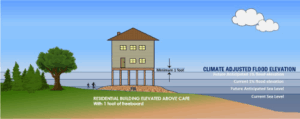

The first habitable floor (not grade level) in a floodplain for a single-family home must now be elevated to the new Coastal Area Flood Elevation (CAFE) standards, which means that the elevation of the first habitable floor level is calculated by adding the Base Flood Elevation (BFE) to the CAFE of 4 feet plus 1 foot Freeboard.
For example, let’s assume the home is in an AE zone where the BFE is 11. To find the minimum elevation the calculation would be as follows:
BFE + CAFE + Freeboard (note, Highlands has a Freeboard of 1 foot)
11 + 4 + 1= 16 Elevation
That does not mean the home must be elevated 16 feet above the ground. To find out how high above adjacent grade (ground) the home must be elevated to you would deduct the elevation of the ground. For example, the average elevation of the ground on Bay Avenue is roughly 5 feet. You would deduct this amount from the elevation of 16, which would give you an indication that the first habitable floor level must sit roughly 11 feet above ground. Of course, the only way to confirm elevations is by hiring a licensed land surveyor and have an Elevation Certificate prepared.
If the home is in an A or Coastal A zone, the lowest structural member would need to be elevated above the BFE + CAFE + Freeboard.